What did the debit actually establish?
The cash entry invokes a payment saga coordinating investor funds, the collection account and the order. A successful payment is not TA confirmation and does not establish ownership of fund shares.
Bank wealth · a declaration guide
Not yet. Payment, fund-company confirmation and a possible refund are different business facts. Follow their declarations to see why they need different consistency boundaries—and how each installment reuses them.
This page is a static guide, not a live bank backend or browser simulation. The linked graph is the shipped declaration snapshot. The separately tested local demo uses a mock transfer agent (TA), not a real fund-company connection.
Choose a business question · Inspect the source views · Read technical acceptance
The arrows below are a reading order through declarations, not an execution trace or proof that one graph edge causes the next action. Links select actual nodes in the 2026-11-11 SQLite snapshot F-03.
The cash entry invokes a payment saga coordinating investor funds, the collection account and the order. A successful payment is not TA confirmation and does not establish ownership of fund shares.
The refund request checks the selected successful payment and a rejected TA status. It starts an independent refund business flow; it is not compensation for the already committed payment. The refund saga has its own outcomes.
TA rejection → Refund request guards → Independent refund saga
A sealed finite schedule and a retained occurrence identify what may be dispatched into the cash flow. Dispatch success is not investment success; correlated business terminals update installment results.
Seal the schedule → Admit an installment → Dispatch to cash
Read the paused-slot skip guards. This is explicit slot classification, not a policy of automatically pausing after three failures.
“Unknown” must not be relabeled “failed” or “succeeded.” TA observations and installment progress have explicit unknown declarations. The cash and SIP plans require reconciliation before resuming an unknown effect; a missing answer is not permission to repeat a debit.
Inspect TA unknown observation · Inspect installment unknown progress
Payment success ≠ investment success · TA acceptance ≠ share confirmation · independent refund ≠ compensation of a committed payment · saga transaction boundary ≠ pipeline flow order. Read the declarations here; use the separately scoped acceptance below for execution evidence.
External-contract references and observation-to-business-command translation declarations still need a joint version-resolution design (DEF-22); existing contracts and version checks are not a complete declaration-level consistency loop.
An older workshop viewer capture, generated 2026-11-06 by view-project --html. The Chinese single-file snapshot preserves its chapters, evidence panel and search and opens offline; it is not the new technical run.
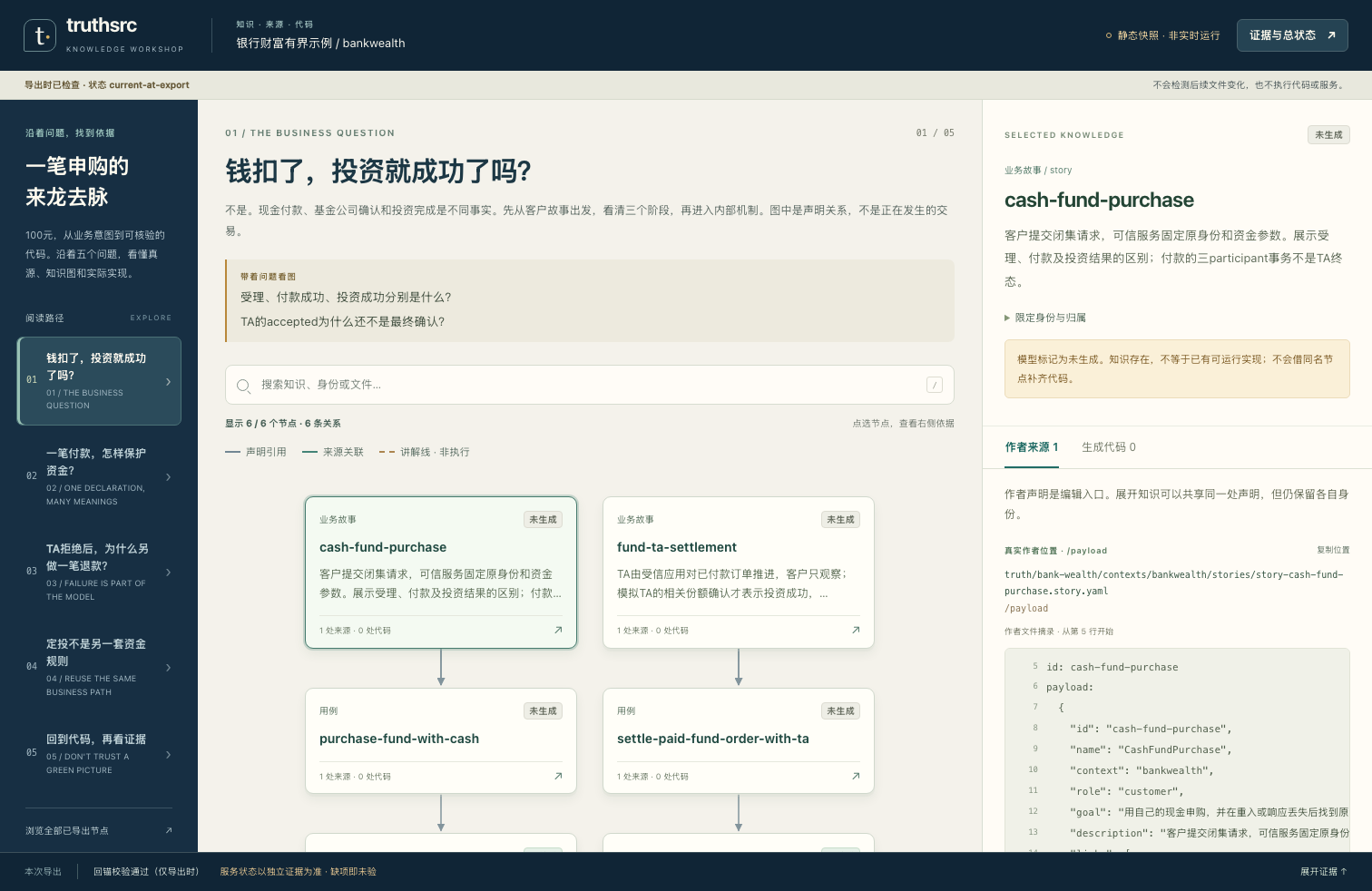
Prefer querying to browsing? The Explorer loads a different, 2026-11-11 capture: 389 nodes / 413 edges F-03 as SQLite in your browser — blast radius, lineage, orphans, free SQL.
For knowledge ↔ code navigation, use the same Explorer’s Code view, not a separate browser inside the running bank demo. The bank snapshot passed complete source/anchor verification and real browser round-trips (F-30); no new service execution is claimed.
The workshop subset and Explorer use different dates, representations and counting scopes (three graph representations); their totals are not a like-for-like growth or decline measurement.
A journey, context map or event-flow view offers another way to discuss the model. It remains a derived design view, not a new source of business truth or evidence that a service ran.
Use the historical workshop’s chapters, search and evidence panel to move between explanations. Use the Explorer to inspect its own declared snapshot. Do not infer matching code locations from shared names across the two exports.
Start with the bank source repository. For commands and prerequisites, use the guide’s bank path, not this page as a runbook. Repository contents can evolve; the figures here retain the 2026-11-11 capture.
The 149 @rule entries count declarations across the three aggregates, not independently proved invariants or distinct tests.
Source validation recorded 0 hard findings and byte-identical roundtrip F-01 / F-02. The build recorded 235 generated files F-04, 0 errors across 534 sources F-06 and 792 verified anchors F-05. The 23/23 result is generated unit tests, not independent handwritten business tests F-07.
npm run project writes generated/current/; its convenience path can fetch pinned 0.3.0 engines from Maven Central and verify SHA-256 F-23. That does not supply the formal workshop archive and sealed runtime materials or constitute formal service acceptance.
The formal source / anchors / code / service scopes have distinct inputs and environments. This is not a one-command public service reproduction.
bank030-relocated-20261112-02 passed and rechecked source / anchors / code / service after actual relocation of the paired sources; fullPipelinePassed=true, no diagnostics F-24. The sanitized technical summary records the scope and report identities; it is not the original reports or a public reproduction package.
This remains a local teaching demo: no real money, no production certification or real fund-company connection, and no Palantir compatibility claim. The historical P23/service02 replay failure remains failed (DEF-06); it does not describe the new technical candidate.
Independent start/status/page-operation/stop experience remains open (DEF-07): session03 did not reach readiness, later slot cleanup was not a pass, and the later fix candidate is recorded as unexecuted. Automated HTTP/browser observations do not sign off that experience or the original manual sbt run smoke.
The engines are public on Maven Central F-23, but matched-material delivery (DEF-15), human acceptance (DEF-16), family observations (DEF-17), retry/backoff/deadline debt (DEF-18), targeted Inspector negatives and extra Node CI/typecheck (DEF-19), and legacy offline-bundle migration (DEF-20) remain separate, unclosed items.